
No matter how carefully you plan a Team-Based Learning (TBL) session, the discussion will not always go as expected.
A few students may dominate the conversation. Teams may agree too quickly. An interesting question may take the discussion away from the intended learning objective.
In these moments, facilitators need to decide when to step in, when to ask another question, and when to simply let students work through the issue themselves. Interestingly, this is an aspect of TBL facilitation that’s similar to jazz.
Jazz musicians may improvise in the moment, but they do so by drawing on practiced techniques, careful listening, and experience. TBL facilitators can develop these same skills to navigate the complexities of classroom discussion.
In this blog, we’ll explore three improvisation skills that can help facilitators respond more effectively to what happens in the room.
Improvisation Skill #1: Build Your Repertoire
Jazz musicians do not improvise from nothing. Over time, they build a collection of familiar musical ideas or “licks” that they can draw on and adapt depending on the moment.
TBL facilitators can build a similar repertoire of techniques for guiding discussion. The TBL Facilitation Grid offers one way to do this by organizing different facilitation moves around three broad stages of discussion: Discovery, Examination, and Commitment.
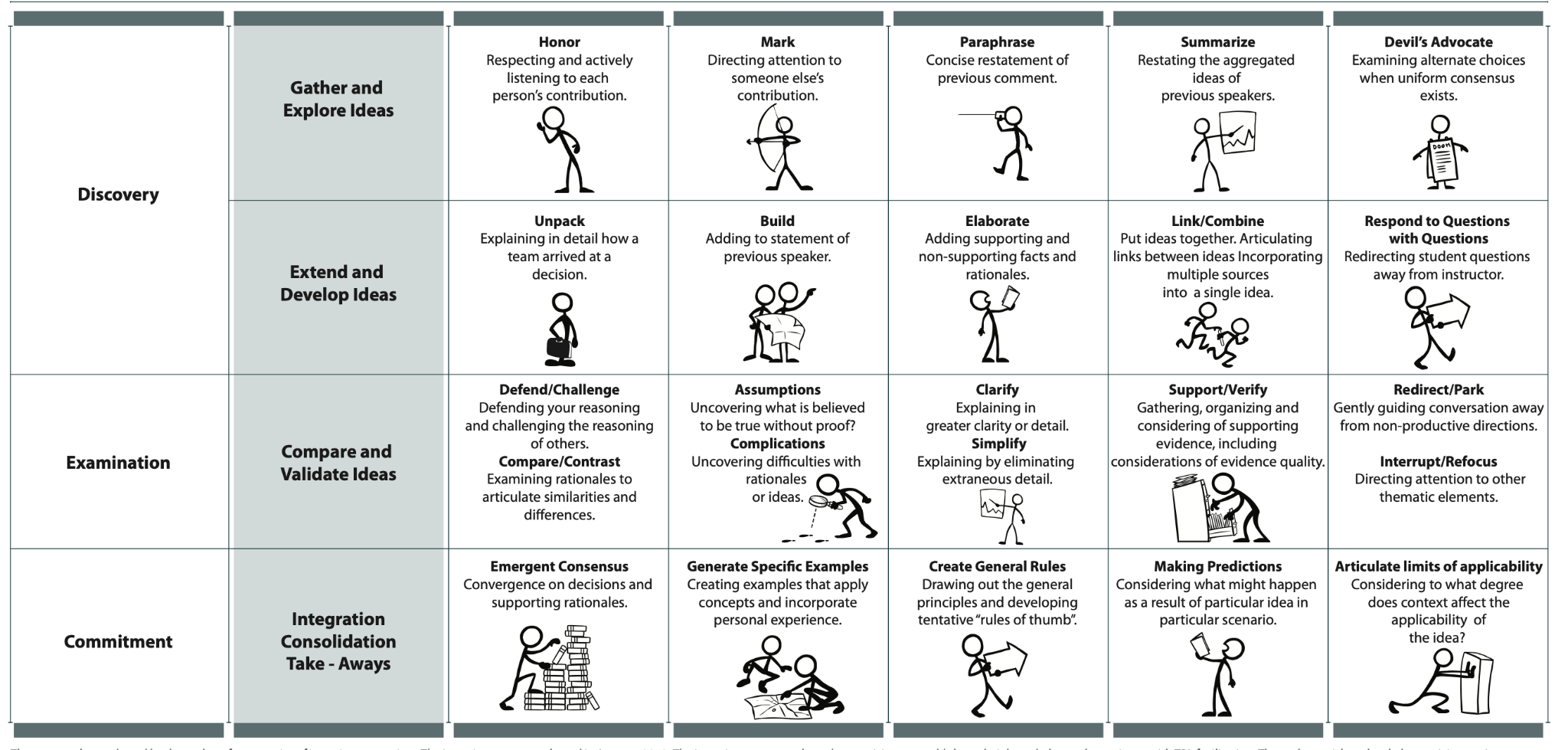
TBL Facilitation Grid (By Loretta Whitehorne, Larry Michaelsen and Jim Sibley)
Rather than following the grid from beginning to end, educators can use it to consider what the discussion needs at a particular moment.
Do students need help exploring an idea more deeply? Is it time to examine and challenge their reasoning? Or do they need support connecting different ideas and arriving at meaningful takeaways?
The goal is not to use every technique in every session, but to build a broad enough repertoire to respond effectively to different facilitation challenges as they arise.
The grid gives facilitators a range of possible moves for each of these situations. Over time, educators can become more familiar with these techniques and draw on them more instinctively as different facilitation challenges arise.
Improvisation Skill #2: Develop Your Own Educator Voice
In jazz, different musicians can perform the same piece, or even play the same instrument, and still sound completely different. Over time, each develops a distinctive voice, shaped by how they interpret, respond, and make choices in the moment.
The same is true for TBL facilitation. There is no single “right” way to facilitate a discussion. Some educators may naturally be more comfortable asking probing questions, while others may be particularly good at summarizing ideas, drawing connections between teams, or challenging assumptions.
The goal is not to copy another facilitator’s style, but to understand your own. You can consider which behaviors on the TBL Facilitation Grid already fit naturally into the way you teach, and which ones may require more deliberate practice.
Expanding your repertoire in this way can help you develop a facilitation style that feels authentic while giving you more ways to respond when discussions become challenging.
Improvisation Skill #3: Learn to Accompany, Not Always Lead
In jazz, the musician who is not soloing still plays an important role. Good accompaniment means listening closely, supporting the lead musician, and knowing when to contribute without taking over.
TBL facilitators can take a similar approach. Rather than stepping in with an explanation every time students hesitate or ask a question, educators can create space for teams to work through their reasoning themselves.
This might mean listening for misconceptions, asking a follow-up question, inviting another team to respond, or simply allowing a discussion to continue a little longer before intervening.
The key is to stay actively engaged without becoming the main voice in the room. Sometimes, the most effective facilitation move is knowing when to step back and let students lead the learning.
Keep Developing Your Improvisational Skills
Like jazz, effective TBL facilitation is something that develops with practice. The more educators build their repertoire, become comfortable with their own facilitation style, and learn when to lead or step back, the more confidently they can navigate the unexpected moments that arise during discussion.
To explore these ideas in greater depth, you can watch the full Jazz and TBL: Improvisation Skills for Facilitating Great Sessions workshop recording below. You can also join the InteDashboard TBL Community, where 700+ fellow TBL educators connect to exchange ideas, share classroom experiences, ask questions, and learn from one another.